Table of Contents
- A Quick Note on Methodology
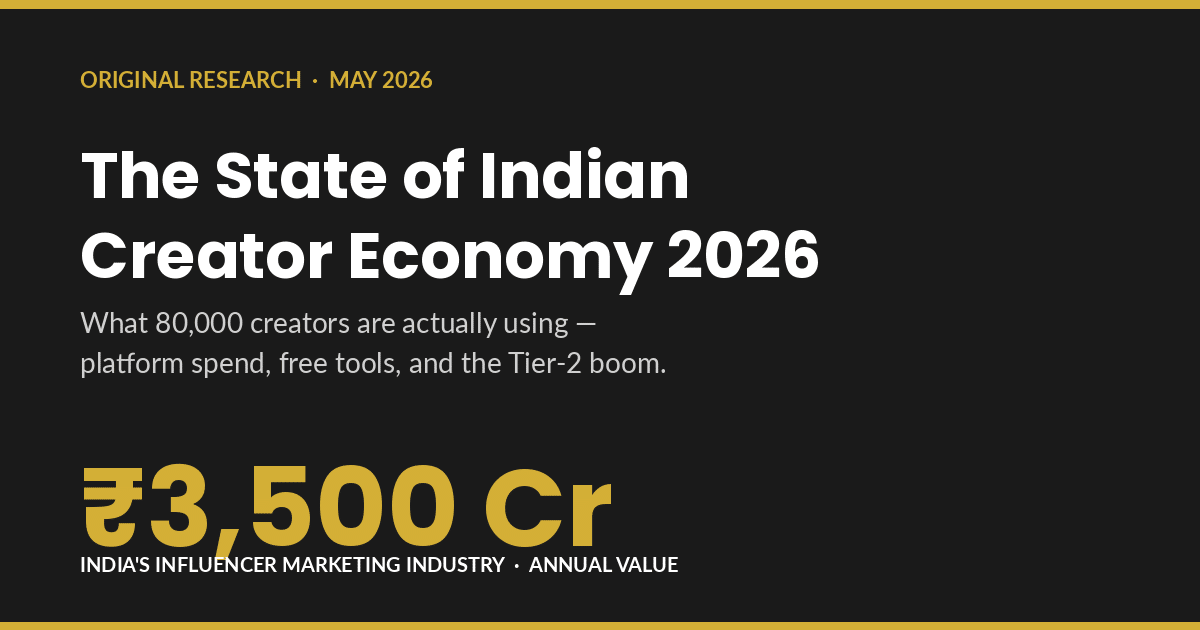
- The Big Picture: India’s Influencer Marketing Industry Is Now Worth ₹3,500 Crore
- Platform Wars: Where Indian Creators Actually Spend Their Time
- What Creators Pay For (and Why Instagram Dominates)
- The Free Tools Revolution Nobody Is Reporting
- The Tier-2 Boom: Lucknow, Indore, Coimbatore Are Creating
- Six Trends We’re Betting on for the Rest of 2026
- What This Means for Brands and Marketers
Indian Creator Economy 2026 – India now has over 500 million active social media users and more than one billion internet users, according to Data Reportal’s Digital 2026 India report. Behind that headline sits a quieter shift — a growing class of full-time creators in cities most reports still don’t track. We pulled together what we see from inside the platform serving 80,000+ Indian creators since 2013, and combined it with what credible third-party research is now reporting.
This is what we found.
What’s Inside
- A quick note on methodology
- The big picture: India’s influencer marketing industry is now ₹3,500 crore
- Platform wars: Where Indian creators actually spend their time
- What creators pay for (and why Instagram dominates)
- The free tools revolution nobody is reporting
- The Tier-2 boom: Lucknow, Indore, Coimbatore are creating
- Six trends we’re betting on for the rest of 2026
- What this means for brands and marketers
A Quick Note on Methodology
What’s in this report: Aggregated, anonymised observations from SocialKing’s platform between January 2024 and April 2026, covering 80,000+ paying customers and approximately 1,50,000 monthly users of our free creator tools.
What’s also referenced: Public industry research from Kofluence’s Influencer Marketing Report 2025, Inc42’s State of Indian Startup Ecosystem 2024, NITI Aayog’s policy brief on India’s gig and platform economy, and DataReportal’s Digital 2026 India report.
What we’re not claiming: Survey data we didn’t run. Wherever we cite a specific national-level number, the source is named. Wherever we describe what’s happening on our platform, we say so plainly.
One more thing — this report focuses primarily on India, where 90% of our user base sits. Some observations may extend to South Asian creators broadly, but we’d rather be specific than sweeping.
The Big Picture: India’s Influencer Marketing Industry Is Now Worth ₹3,500 Crore
For a long time, the Indian creator economy was discussed in the future tense. “It will grow.” “Brands will spend more.” That tense has now changed.
India’s influencer marketing industry has crossed ₹3,000–₹3,500 crore in annual brand spend, according to Kofluence’s 2025 Influencer Marketing Report (also covered by Storyboard18). That same report puts the active Indian creator base at 3.5–4.5 million people. Ecommerce now accounts for roughly 23% of brand influencer spend, with FMCG close behind at 19%.
Indian Influencer Marketing Industry — Annual Brand Spend (₹ Crore)
What is more interesting than the headline number is who is generating it. The romantic story of the creator economy used to be about Mumbai-based travel vloggers and Delhi fashion influencers with English-speaking audiences. That story is partly true. It is also less than half the picture in 2026.
The actual pattern: a substantial chunk of the action is now in Tier-2 and Tier-3 cities, where smartphone-first creators are building Instagram and YouTube audiences in Hindi, Marathi, Tamil, Bengali, and a dozen other languages. We’ll come back to this in the geography section.
Platform Wars: Where Indian Creators Actually Spend Their Time
The honest answer to “which platform matters most” is dull but accurate: Instagram. Then a gap. Then YouTube.
Looking at our own customer base — creators actively paying for Instagram growth services — Instagram accounts for roughly 7 in every 10 orders. YouTube sits second. Facebook is still alive (mostly for B2B and older audiences). X (Twitter) is small but punches above its weight for journalists, founders, and policy commentators. Everything else combined is roughly 8%.
Where Indian Creators Spend on Growth Services (SocialKing, 2024–26)
What that picture hides is the underlying behaviour shift. Two years ago, YouTube was closer to 22% of our paid orders. Today it is 14%. Most of that decline did not go to YouTube competitors. It went to Instagram Reels — which absorbed a huge slice of what creators previously treated as YouTube territory.
Kofluence’s data backs this up: between 1.8 and 2.3 million Indian creators are now actively producing content on Instagram, with short-form Reels the dominant format for monetisation. We see the same shift in what creators ask for. Three years ago, the top order was “YouTube subscribers.” Today, it is Instagram Reel views.
Reels has not just won short-form. It has eaten into long-form’s territory in India because the algorithm rewards consistent posting more aggressively than YouTube does for non-monetised creators.
Aggregated observation from SocialKing platform team
X (Twitter, now officially X) is interesting in a different way. Indian creators don’t go to X to grow — most use it to be heard. Journalists, policy people, startup founders. They want the impressions, not the followers.
What Creators Pay For (and Why Instagram Dominates)
If you look only at our top three services across all platforms — which together account for over half our order volume — the picture is clear.
Those three are, in order:
- Instagram Video Views — the single biggest service category. Driven almost entirely by Reels.
- Instagram Likes — particularly for new posts. Creators use this for the early-momentum signal.
- Instagram Followers — used mostly by creators in the 1K–10K range who want to cross a “credibility threshold” before pitching brands.
The third one is worth dwelling on. We see a pattern around the 5,000-follower mark — creators below that count have a noticeably harder time landing their first brand deal. Indian micro-influencers in particular treat this number as a psychological gateway, even though the actual engagement rate matters more.
Pricing patterns we observe
Indian creators are sharp price-shoppers. The median first order on our platform is small — around ₹250–₹400. Most users place their first order to “test” before scaling. About 40% of paying customers come back for a repeat order, which is high for any e-commerce category.
The other thing creators do — almost universally — is bundle. They will pair a small follower order with a likes order on the same post. They are not buying vanity. They are buying signal stack, which the Instagram algorithm appears to read collectively. See our services and pricing page for current rates.
The Free Tools Revolution Nobody Is Reporting
Here is the part of the creator economy story that almost nobody covers. While brand-spend reports get all the attention, the bigger volume on the ground is unpaid usage of free creator tools.
On SocialKing alone, over 1,50,000 creators each month use our free downloaders — Reels download, Story save, Photo download, Video grabber. None of these involve a payment. None of them generate revenue for us directly. And yet they are arguably the most important data we have for understanding what Indian creators actually do.
Why do creators download other creators’ content? Three reasons we see consistently:
- Inspiration scraping. Creators study competitors. They save Reels in the same niche to understand pacing, hook structure, captions, and audio choices.
- Repurposing. A successful Reel gets cross-posted to YouTube Shorts, WhatsApp Status, and sometimes back to Instagram from a second account.
- Archival. Stories disappear. Many creators save their own and others’ Stories before they expire.
Most-Used Free Tools (SocialKing, monthly volume)
The dominance of Reel downloading tells you something important: short-form Instagram content is now the unit of currency in the Indian creator economy. Stories are second because they’re ephemeral and have urgency. Photo posts are barely a rounding error.

This usage cuts cleanly across language and geography. A creator in Bhopal downloading a Reel from Mumbai for inspiration is the same behaviour as a Mumbai creator downloading a US creator’s Reel. The tools are a universal infrastructure now.
Why free tools matter for brand-side marketers
If you are a brand or agency reading this, the free tools data has an interesting implication. The biggest signal of what is about to break out is not what creators are posting. It is what they are saving and studying. By the time a format is dominant in posted content, it is already mainstream. Tracking what is downloaded gives you a 4–6 week head start.
The Tier-2 Boom: Lucknow, Indore, Coimbatore Are Creating
This is the part that has surprised us most over the last 18 months.
When we started in 2013, almost every paying customer was from one of six cities — Mumbai, Delhi NCR, Bengaluru, Hyderabad, Chennai, or Pune. Today, less than four in ten of our active users are from those cities.
Active Creators by City Tier (SocialKing, April 2026)
The five cities driving the most new creator signups in 2025 and 2026 on our platform are, in order: Lucknow, Indore, Coimbatore, Bhopal, and Surat. None of them are in the traditional top 8.
What is happening here is partly infrastructure (cheap data, affordable smartphones) and partly economics. A creator in Indore producing Hindi content can earn the same per-Reel ad rate as one in Mumbai — but with one-third the cost of living. The same content business that breaks even at 50K followers in Mumbai is profitable at 20K in a Tier-2 city.
Language is the second driver. Hindi creator content has finally outscaled English on Indian Instagram, and Tier-2 city creators are largely producing in regional languages — Bhojpuri, Marathi, Punjabi, Tamil, Telugu, Bengali. The audience exists for them in a way it did not five years ago.

The macro implication for brands
If you are a brand and your influencer marketing roster is still 80% Tier-1 metro creators, you are missing roughly two-thirds of where the actual audience lives. The agencies that figure out scalable Tier-2 city creator sourcing in the next 18 months are going to take a meaningful share. Kofluence’s 2025 data lines up with what we see — regional content and micro-influencers are reshaping the ₹3,500 crore industry.
Six Trends We’re Betting on for the Rest of 2026
This is the part of the report where we put our neck out. Based on what we see in our own platform data and what credible third-party research is showing, here are six bets we’d make for the next 6–12 months.
1. Vertical video is no longer optional
If your content is not vertical-first, it loses by default. Reels, Shorts, and TikTok-replacement content will keep absorbing time on every major platform. Horizontal video survives only in two niches: deep tutorials and podcasts.
2. The “5,000 followers gate” will widen to 10,000
As more creators flood the market, brands will keep raising the floor for paid partnerships. The micro-influencer space (1K–10K) is going to get squeezed. Mid-tier creators (10K–100K) will benefit.
3. Regional language content will outpace English
It already has on most metrics. Brand spend has not fully followed yet. By end-2026, we expect Hindi + regional language creator deals to overtake English-language deals in volume — not just for FMCG, but also fintech, edtech, and even premium D2C.
4. WhatsApp Status will become a legitimate content channel
Creators are already cross-posting to Status. Brands and platforms have largely ignored it. We expect that to change, especially as Meta opens more monetisation infrastructure inside WhatsApp.
5. AI-assisted content will hit a quality backlash
AI-generated thumbnails, voiceovers, and scripts are everywhere right now. Kofluence’s 2025 report shows 29% of brands have already adopted generative AI for creative development. By end-2026, we expect audiences and algorithms to start penalising obvious AI output, especially in trust-sensitive niches like finance, health, and parenting. Hybrid (human + AI tool) wins. Fully AI loses.
6. Free creator tools will consolidate
There are too many single-purpose download tools and schedulers right now. Over the next year, we expect creators to gravitate toward 3–4 dominant suites — and the platforms that handle multi-platform workflows in one place will absorb the rest.
What This Means for Brands and Marketers
If you are reading this from the brand side — whether you are a marketing manager at a Mumbai D2C company or part of an agency running creator campaigns across India — here is the short version of what to act on.
- Stop over-weighting Tier-1 metros. Build a Tier-2 city sourcing pipeline. Lucknow, Indore, Coimbatore, Bhopal, Surat. Start there.
- Allocate at least 30% of your creator budget to non-English content. If you are not, your competitor is.
- Don’t chase follower counts alone. Engagement rate, saves, and Reel watch-time matter more.
- Track what’s being downloaded, not just what’s being posted. It’s a leading indicator.
- Mid-tier creators (10K–100K followers) are now your sweet spot. Better ROI than mega-influencers, more scalable than micros.

Working on a story or campaign?
If you are a journalist, researcher, or marketer working on something related to India’s creator economy, we are happy to share anonymised platform data, comment on findings, or jump on a quick 15-minute call.
Get in touch →That’s the picture from where we sit. India’s creator economy is bigger than the brand-spend headlines suggest, more geographically distributed than most reports admit, and changing in ways that will reshape how brand-creator partnerships work for the next five years. For media enquiries and the full press kit, visit socialking.in/press. Learn more about SocialKing.
Sources: Kofluence Influencer Marketing Report 2025 · Inc42 State of Indian Startup Ecosystem 2024 · NITI Aayog Gig & Platform Economy Policy Brief · DataReportal Digital 2026 India · Statista — Social Media in India. Internal SocialKing platform data is aggregated and anonymised. This is observational research, not survey research.
Social King Team
SocialKing Team is a dedicated group of social media experts and developers committed to building tools and strategies that empower creators and businesses. With combined expertise spanning social media growth, content optimization, algorithm research, and platform-specific strategies, the SocialKing team regularly shares actionable insights, product updates, and industry trends through our blog. Our mission is to make social media success accessible, transparent, and effective for everyone.
Get social growth tips in your inbox
Join the SocialKing newsletter — no spam, unsubscribe anytime.


