Table of Contents
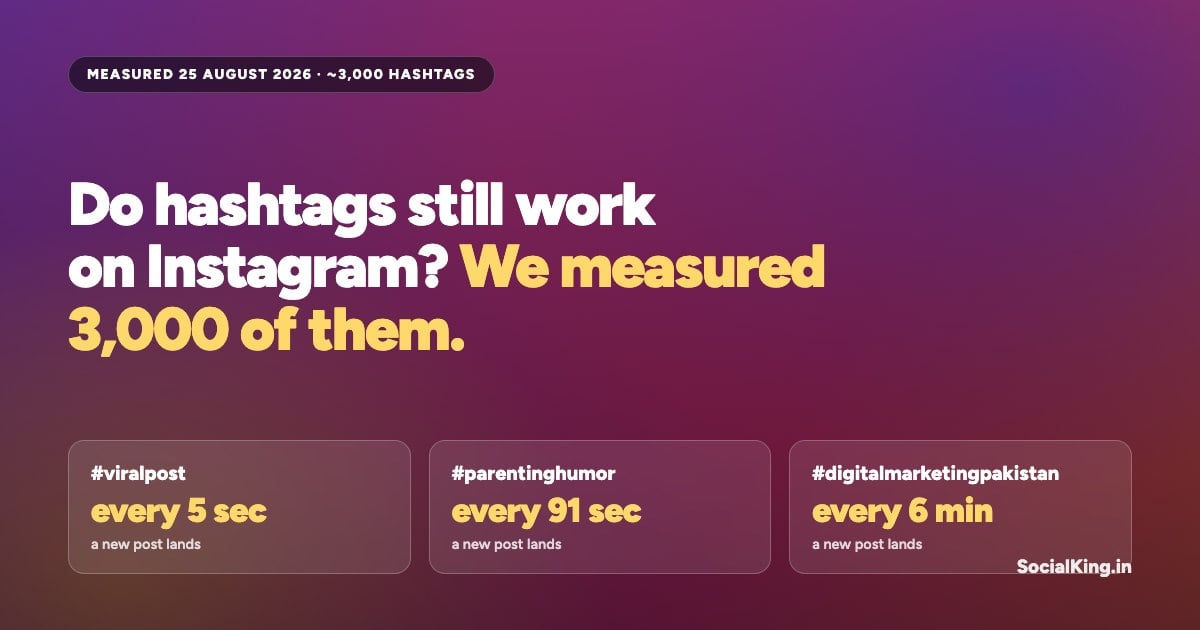
On 25 August 2026, a new post landed on #viralpost every five seconds. On #digitalmarketingpakistan, one landed every six minutes. Same app, same day, a 70x difference in how much company your post has. That gap is the honest answer to whether hashtags still work — and it is not the answer most guides give you.
Do hashtags still work on Instagram?
Not the way most people hope. Hashtags do not lift your reach on their own. Instagram's head, Adam Mosseri, has said so directly: hashtags are "a great way to let people know what your post is about", useful for search, but "generally speaking, no, hashtags do not improve your reach."
What they still do is label your post. That label decides which searches and topic surfaces you are eligible to appear in. Eligibility is not distribution — being in the room is not the same as being seen — but you cannot be found in a room you never entered.
The clearest test of the popular belief comes from a 2022 IEEE study of 232 small Instagram accounts covering 113,247 hashtags, using the accounts' own reach figures rather than public like counts. It found no relationship between how many hashtags an account used and the reach it got. What did differ was the kind of tag: accounts using informative hashtags reached more people than accounts using self-describing ones.
What changed in December 2025
On 18 December 2025, Instagram's @creators account announced that it "will gradually update the number of hashtags that you can include in a caption for a reel or post to five", adding that fewer, more targeted hashtags improve both performance and people's experience on the app.
The old ceiling was thirty. That single change makes a large share of hashtag advice on the internet obsolete, and most of it has not been updated. If a guide recommends nine, eleven, fifteen or thirty hashtags, check its date — it was written for a rule that no longer exists.
It also settles an argument that consumed years of blog posts. There is no research-backed optimal number: the two largest industry datasets on the question contradict each other outright, and one of them was published by a company selling hashtag tools. The count is now decided for you. Only the choice remains.
What a hashtag page actually looks like now
This part matters more than it sounds, and almost nobody checks it.
We opened #rakhi in the Instagram iPhone app on 25 August 2026. The tabs across the top were For you, Profiles, Audio and Tags. There is no Recent tab, and no Top tab either. The grid that loads is ranked, not chronological — the first posts we saw carried 44.1 million, 15.1 million and 10.2 million views.

Instagram began removing the chronological Recent tab as a test in April 2022. It never came back. So the mental model behind most hashtag advice — your post lands at the top of a fresh feed and slides down as newer ones arrive — describes a screen that has not existed for years. Your post does not get pushed down. It has to earn its way in.
How crowded is a hashtag? We measured
Instagram publishes only a hashtag's lifetime total, never its history. So the number nobody can look up is the one that matters: how fast is this tag actually moving right now?
The only way to get it is to measure it. We read the post count of about 3,000 hashtags once a day and store every reading with its timestamp. The difference between two dated readings, divided by the hours between them, gives the arrival rate. Across the readings taken on 24 and 25 August 2026 — a window of roughly 21.9 hours — this is what four tags looked like:
- #viralpost — 121.4M posts, 12.37 new posts a minute, one arriving every 5 seconds
- #rakhi — 4.3M posts, 4.26 a minute, one every 14 seconds
- #parentinghumor — 803K posts, 0.66 a minute, one every 91 seconds
- #digitalmarketingpakistan — 31K posts, 0.17 a minute, one every 6 minutes

Note what the lifetime totals do not tell you. #rakhi and #parentinghumor differ by roughly 5x in total posts but by more than 6x in arrival rate — and the smaller tag is the calmer one by a wider margin than its size suggests. Total posts is a measure of the past. Arrival rate is a measure of now. You can see the daily hashtag measurements behind this for the current figures.
Why your hashtags feel like they aren't working
Because on a crowded tag, nothing you do is visible enough to produce feedback. When twelve posts a minute are landing on the same label, your post is one of roughly seven hundred that hour. It has not been rejected. It has been outnumbered.
This is the part worth internalising: an underperforming post is usually a structural outcome, not a verdict on your content. Research on attention and networks has shown that finite attention plus network structure alone is enough to produce exactly this pattern — no difference in the quality of the underlying idea is required to explain it.
The pressure is also increasing. Analysing roughly 43 billion tweets, a 2019 study in Nature Communications found the average time a hashtag held a place in Twitter's global top 50 fell from 17.5 hours in 2013 to 11.9 hours in 2016 — more content competing for the same fixed pool of attention. That measures how long a topic stays popular rather than how long a single post stays visible, but the direction is the same one our own readings show.
How to choose your five
Pick by arrival rate, not by size.
A practical mix for a small account: three or four tags that are genuinely specific to what is in the post, plus one larger tag. The specific ones are where you are a real candidate rather than a rounding error. The larger one costs you a slot and occasionally pays for itself.
Two rules that follow from the measurements. First, a tag arriving faster than once every few seconds is not useless — it is useless alone, which is a different thing. Second, relevance is not a tiebreaker but the whole test: with five slots, an irrelevant tag spends a fifth of your allowance putting you in front of people with no reason to stop.
We should be straight about the limits of this advice. No randomised trial on hashtag effectiveness exists anywhere. Every published result on the subject, ours included, is correlational. What we can show you is the clock.
What we can't measure
Some hashtags do not move. Of the 1,870 tags with at least two readings on 25 August 2026, 95% had counters that changed between readings and 5% did not. Those frozen counters are almost entirely small tags — 23% of tags under 100,000 posts, against effectively zero in every band above that — which is what you would expect when a genuinely quiet tag gains nothing in a day.
The very largest tags are a harder problem. #love and #fyp cannot be measured at all: Instagram's search does not return them as themselves, only their variants. And a rate measured over one day is a rate for that day. A festival tag behaves differently the week before the festival than the week after.
Where to get today's numbers
The figures above are a snapshot of one day. They will be wrong next week, which is the point — that is what makes them worth measuring rather than guessing.
Our Instagram trending hashtags tool publishes the current readings, re-measured daily, with the exact window each one was measured over. You can also paste the set you already use under your posts and see the arrival rate for each tag in it.
Frequently Asked Questions
Do hashtags work on Instagram Reels?
Do hashtags work on Instagram Stories?
Are Instagram hashtags dead?
Are Instagram hashtags still relevant in 2026?
How do I tell if a hashtag is banned?

Social King Team
SocialKing Team is a dedicated group of social media experts and developers committed to building tools and strategies that empower creators and businesses. With combined expertise spanning social media growth, content optimization, algorithm research, and platform-specific strategies, the SocialKing team regularly shares actionable insights, product updates, and industry trends through our blog. Our mission is to make social media success accessible, transparent, and effective for everyone.
Get social growth tips in your inbox
Join the SocialKing newsletter — no spam, unsubscribe anytime.


